Monster of the Week: The Beholder

0
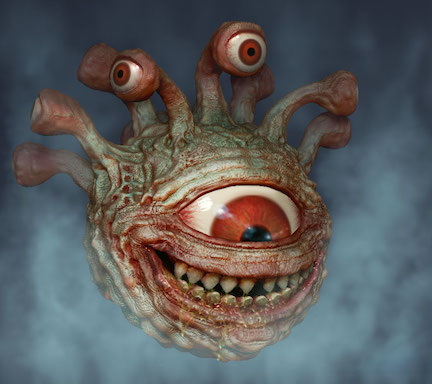
Beholder by Hungrysparrow

Beholder © by Hungrysparrow at Deviantart.

The Beholder is a cruel and rapacious monster from the world of Dungeons & Dragons (D&D). Unlike most other creatures found in the various versions of the role-playing game since its original 1974 release, the Beholder is unique to the D&D realms, and not based on any other monster.

Usually found underground in large, cavernous spaces, the Beholder is a floating monster with a spherical shape. It has one large eye, and ten smaller eyes on stalks. The D&D Monster Manual describes the Beholder’s appearance as “covered in chitinous plates, scales, or leathery flesh. Its great bulging eye sits above a wide, toothy maw, while the smaller eyestalks that crown its body twist and turn to keep its foes in sight.” Continue reading

Monster of the Week: Gabriel

18
Every angel is terror.
—Rainer Maria Rilke, Duino Elegies, 1923
Gabriel in a fresco from the Tsalenjikha Cathedral by Cyrus Emanuel Eugenicus. 14th c.

Gabriel in a fresco from the Tsalenjikha Cathedral by Cyrus Emanuel Eugenicus. 14th c.

The Angel Gabriel (גַּבְרִיאֵל , جبريل) is known throughout the Abrahamic faiths of the world. An archangel by tradition, if not by rank, Gabriel sits at the hand of God. He is called Saint Gabriel in many of the Orthodox Christian Churches, and is the patron saint of messengers. As a Messenger of God himself, Gabriel is one of the few Heavenly Host who communicates with people directly, often appearing as a mortal man.

Gabriel is also a warrior in many traditions, fighting not only in celestial battles alongside his brother Michael, but also on Earth, assisting the prophet Muhammad with strategic advice in many military campaigns. Continue reading

Monster of the Week: The Slender Man

1

The Slender Man is a very young monster, having only come into existence in 2009, yet his notoriety is widespread. Slender Man is a popular figure in art, cosplay and fiction in the internet “creepypasta” tradition.

Slender Man is usually represented as an extraordinarily tall figure in a black suit and tie, with a featureless, bone-white face. He is often seen to have multiple long tentacles instead of, or in addition to, normal arms. He is associated with dark woodland areas and the disappearance of children. Continue reading

Monster of the Week: The Griffin

3
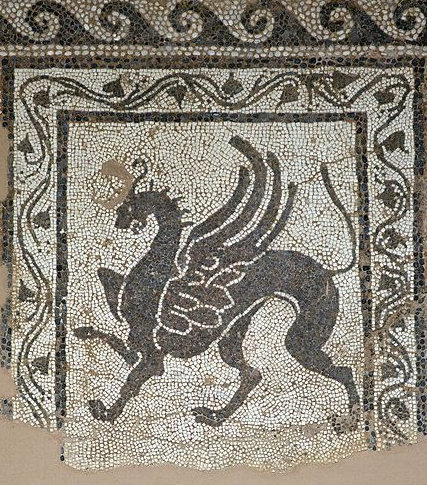
Griffin mosaic from the Acropolis of Rhodes, ca. 200 BCE

Griffin mosaic, Acropolis of Rhodes, ca 200 BCE

…but the Griffin hath a body bigger than eight Lions, and stronger than 100 Eagles, for certainly he will bear to his Nest flying, a Horse and a Man upon his Back, or two Oxen yoked together as they go to Plow, for he hath long Nails on his Feet as great as Horns of Oxen, and of those they make Cups there to drink with, and of his Ribs they do make Bows to shoot with.
—John Mandeville, The Voyages and Travels, 1357

The Griffin (also Griffon, Gryphon, or Grype, among other variants) is a legendary creature with the body of a lion, and the head, wings, and talons of an eagle. Depictions of the griffin date back to 3rd millennium BCE Egypt and earlier, but are also found in ancient Greece, India, and elsewhere around the world. It is said that the feather of a Griffin can cure blindness, and poison will change color when served in a cup fashioned from a Griffin’s talon. Continue reading

The Hoot Owl of Death

5

Birds of omen dark and foul,
Night-crow, raven, bat, and owl,
Leave the sick man to his dream—
All night long he heard your scream.
— Sir Walter Scott

Throughout many cultural traditions, Owls have been considered harbingers of bad luck, ill health, or death.

In most Native American tribes, Owls signify death. The call of the Owl is considered an unlucky omen. Some tribes believe the hoot of an Owl indicates that someone is going to die. Owls are known as messengers and companions for the gods of death. As a messenger of death, the Owl is not evil, but it can be foreboding. They carry messages from beyond the grave and when tribal taboos are broken, Owls deliver a supernatural warning. Owls are associated with ghosts among some Native American tribes because it is understood that the bony circles around an Owl’s eyes are made from the fingernails of ghosts.

Continue reading

Monster of the Week: Kasha

2
kaibutsu_ehon_4

Kaibutsu Ehon (Illustrated Book of Monsters), illustrated by Nabeta Gyokuei, 1881.

Kasha (火車) are a Japanese yōkai that bring the bodies of miscreants to hell as punishment for a life of evil deeds. Kasha are feline demons who are human-sized or larger and walk upright. When Kasha seek to make themselves known, they may be surrounded by flames and their arrival may be signified by the presence of thunder and strong winds. Thus, a Kasha’s appearance will often coincide with stormy weather. When Kasha wish to remain hidden, they can disguise themselves as ordinary cats and live among humans. Kasha prefer the night, just as their mortal feline cousins do.

Continue reading

The Changeling

4
From "Strange Lands: A Field Guide to the Celtic and British Otherworld" by Andy Paciorek

From Strange Lands: A Field Guide to the Celtic and British Otherworld by Andy Paciorek

A mother had her child taken from the cradle by elves. In its place they laid a changeling with a thick head and staring eyes who would do nothing but eat and drink. In distress she went to a neighbor and asked for advice. The neighbor told her to carry the changeling into the kitchen, set it on the hearth, make a fire, and boil water in two eggshells. That should make the changeling laugh, and if he laughs it will be all over with him. The woman did everything just as her neighbor said. When she placed the eggshells filled with water over the fire, the blockhead said:

Nun bin ich so alt    Now I am as old
Wie der Westerwald,    As the Wester Wood,
Und hab nicht gesehen,    But have never seen anyone
Daß jemand in Schalen kocht.    Cooking in shells! Continue reading

Monster of the Week: Night Marchers

3
Taken near Punchbowl, 2013, by jai Mansson on Flickr. (CC2.0)

Taken near Nuuanu–Punchbowl, Honolulu, 2013, by jai Mansson on Flickr, CC2.0

Night Marchers (huaka’i pō) are spirits of ancient Hawaiian warriors. Though there are those who describe experiences with huaka’i pō, they are infrequently witnessed from close proximity because most who come into contact with them are cursed. Most experiences with Night Marchers involve hearing drums or chants in the distance or seeing their torches far off across a valley, because those familiar with their mana will seek refuge if huaka’i pō are near.

They proceed from the mountain down to the ocean, following ancient paths that take the marchers from their burial sites to previous battlegrounds and other sacred places. Night Marchers may carry the archaic weaponry and wear the regalia of their corporeal time. Huaka’i pō may have the ability to affect their physical environment, because though they are known to float a few inches above the ground, they sometimes leave behind footprints. Continue reading

Monster of the Week: The Dullahan

3

The Dullahan is a headless horseman from the Unseelie Court of the Irish fairy realm. Although in “The Legend of Sleepy Hollow,” the mysterious rider is implied to be only a man in disguise, the early American short story’s antagonist is modeled from legends of the Dullahan.

Sleepy Hollow stampThe Dullahan carry their grotesque, rictal heads with them, either aloft in their hands or in their saddlebags. (They in fact see through the heads’ eyes, though their sight extends vastly farther than human eyes, and through the pitch black of night). Unlike Death itself, the Dullahan rides a steaming stallion of jet black. The Dullahan maintain classic hallmarks of a Death Omen—if it bears a lantern, it is made of human skull. If it wields a crop, it is the spine of a corpse. In some parts of Ireland the Dullahan is seen in a drawn coach rather than on horseback, with a carriage of skin and wheel spokes of bone. Whatever the conveyance, it is surely a terrifying sight. Continue reading

Monster of the Week: The Croucher

2

Then the Lord said to Cain, “Why are you angry? […] if you do not do what is right, sin is crouching at your door; it desires to have you, but you must rule over it.” —Genesis IV:7, 8

croucher

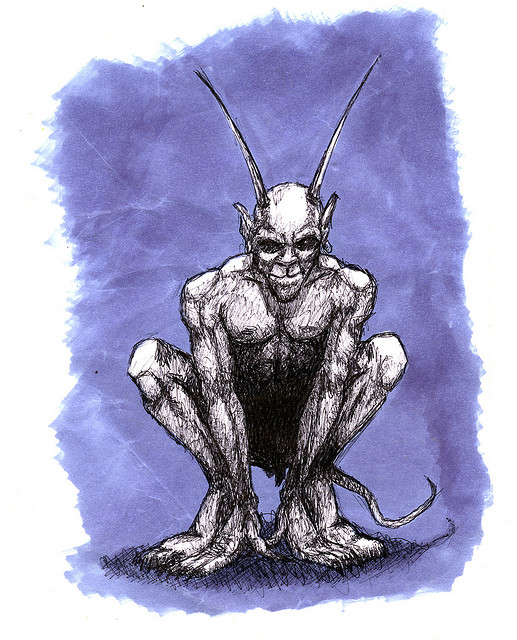
Demon Crouch 1995 by roctopus. CC2.0

The Croucher is an invisible Mesopotanian entrance demon. The customs still observed today of removing one’s shoes before entering a domicile, and carrying a bride over the threshold, may originate with primeval fear of the Croucher. Although unseen, its presence can be felt near doorways when one has the sensation of one’s hair standing on end.

The Croucher is one among many demonic spirits categorized as the rabisu—”those who lie in wait.” While some rabisu, like the Croucher, have been animalistic and vampiric in nature since before the Babylonian Empire, it is believed by some that the rabisu were once malakim of Heaven and fell at the time of the Morningstar’s rebellion, making them amongst the most ancient of earthly demons.

Continue reading