 Hellhounds are great infernal dogs that hunt the damned, guard the underworld and defend their demonic masters. There are tales of hellhounds in ancient Greek and Viking writings, and legends and even stories of sightings can now be found throughout the world. Hellhounds are often described as oversized black dogs with sharp teeth and glowing red eyes. Hellhounds transcend supernatural categories, alternately considered apparitions (the Black Dogs of Britain), creatures of Faerie (the hellhounds of the Wild Hunt) or demons (the Cajedo Negro of South America). Continue reading
Category Archives: Fiendish Creatures
Witches, wendigos, and werewolves—monsters that may be or once were human, but have become something unspeakable.
Monster of the Week: The Ifrit
2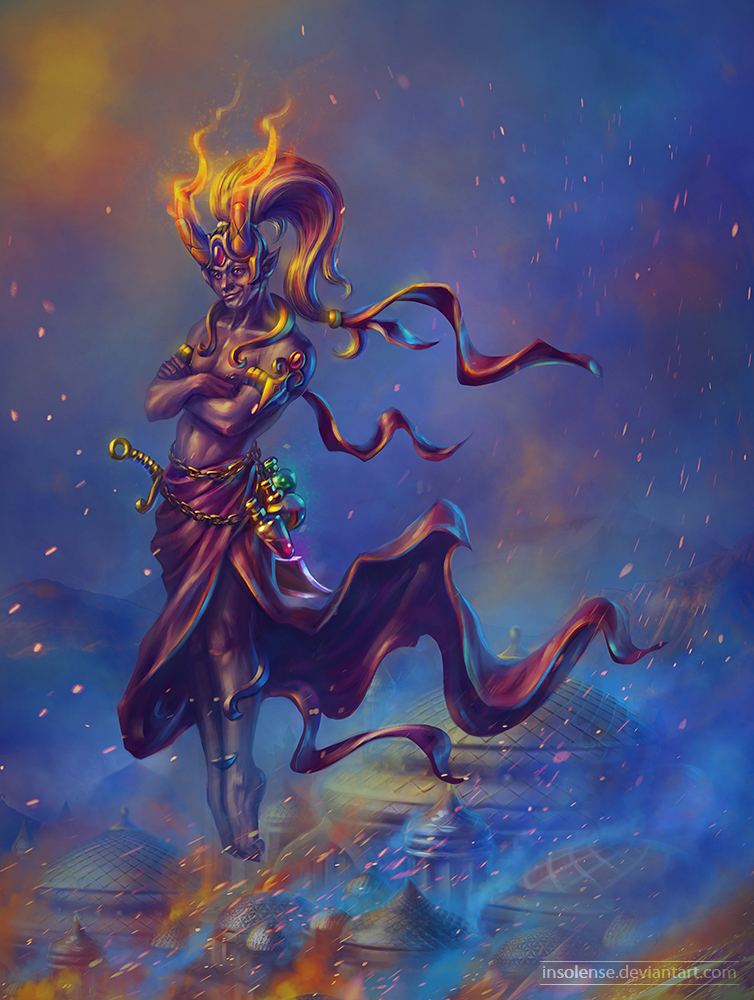
The supernatural creature known as the ifrit* (عفريت) arises out of the rich tapestry of Middle Eastern lore and history. An ifrit is a type of infernal Jinn. The Ifrit is able to generate fire, and withstand smoke and flames.
Traditionally an Ifrit had wings, but more recent incarnations are known for their horns and claws. The Ifrit is known to be formidable and cunning, making it a dangerous enemy.
All You Ever Wanted to Know about Kitsune in Six Minutes
3
Celestial kitsune are sometimes referred to as Inari foxes. Image: Fushimi Inari Fox by Hector Gutierrez
Do you love kitsune? So do we. The kitsune is a yōkai, a supernatural creature. This Japanese fox spirit is known for its mischievious behavior. Some kitsune are benevolent, while others act maliciously towards humans. All kitsune are secretive, so be careful not to stumble upon one. To read more about the kitsune, their abilities, and some of our favorite kitsune in popular American culture, read our Monster of the Week piece about these magical creatures.
Monster of the Week: The Pishtaco
6
Marzita the Pishtaco feeding on a client in “The Purge”
The Pishtaco is a South American anthropophage who hunts people in order to eat or steal their body fat. Tales of the Pishtaco began in the Andes during the Spanish conquest of Peru in the 16th century, perhaps when conquistadores were seen to make use of human body fat for unusual purposes, such as dressing battle wounds. This, in combination with the important place of body fat in Andean culture as representative of strength and vitality (the pre-Incan creator deity Viracocha is closely associated with body fat), contributed to the idea of the Pishtaco. Continue reading
Monster of the Week: Cerberus
3
Hercules capturing Cerberus, 1545, by Sebald Beham
Cerberus (Kerberos), the hound of Hades, is a legendary three-headed dog of Greek and Roman mythology. Like his counterparts the four-eyed Norse dog Garmr and the jackal-headed Egyptian god Anubis, Cerberus is the guardian of the gates of the Underworld, tasked to keep out the living and keep in the dead. His back is covered by a mane of snakes, and his tail is described as being that of a dragon or a snake.
Monster of the Week: Kupua
2
Image from: Ephermeral Life… in Hawai`i
Kupua are Hawaiian demigods with shape-shifting abilities. Due to their transformative abilities and supernatural powers, kupua are described variously as heroes, monsters, or tricksters. Some kupua are known to be destructive and vindictive, with a tendency to kill or devour their enemies. There have also been accounts of kupua acting benevolently as kindly spirits watching over their family members or helping the maka`ainana (common people). Kupua are known throughout the Hawaiian islands.
Monster of the Week: Kumiho
17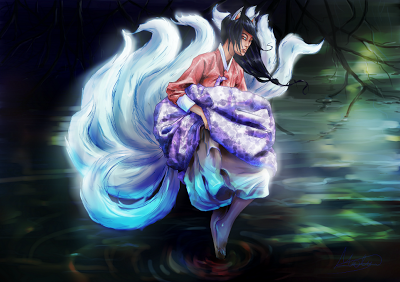
The Kumiho (구미호), or Gumiho*, is a nine-tailed fox spirit. In Korean tradition foxes that have lived for a thousand years, accumulating a great deal of energy, turn into Kumiho. The Kumiho is similar to other fox creatures, such as the Japanese kitsune and Chinese huli jing. Though they have similar magical abilities and longevity, Kumiho are more malevolent than other fox spirits. Of these long-lived legendary creatures, the Kumiho is the only fox that kills and eats humans.
Monster of the Week: The Baba Yaga
5
Baba Yaga of Vertigo’s Fables.
The Baba Yaga (called Baba Jaga in Poland, Baba Roga in Bosnia, Baba Pehtra in Slovenia, and Ježibaba in the Czech/Slovak lands) is a forest-dwelling witch of Eastern European folklore. She is, in many ways, the archetype of the woodland witch, and traits such as the eating of wayward children and flying with brooms may be attributed to legends of the Baba Yaga. In the Skazki (fairy tales) of Russia, she sometimes appears as a trio of “sister” Baba Yagas, much like the Greek Hecatae or gorgons (though when appearing as a trio, these Baba Yagas are usually less sinister, and often helpful). She is described as having a big nose, iron teeth, tangled hair, bony legs and a long reach. The Baba Yaga is very clever and powerful, having control over the elements and the “three riders”—the white horseman of the dawn, the red horseman of the sunrise, and the black horseman of nightfall. In the oldest Baba Yaga stories, her powers resemble those of a goddess more than a witch, and she and her hut act as guardians/gateways to the underworld. Continue reading
Monster of the Week: The Wendigo
10
“Wendigo” by Carver Edlund
The Wendigo, “Spirit of the Lonely Places,” is a monster of the forests of the Eastern United States and Canada—areas of North America with long, cold winters. The Wendigo is said by the Algonquian peoples to be a wild anthropophagic creature created by a human having been possessed by a demonic Manitou spirit. (The name “wendigo” may apply to either the evil spirit or the inhabited physical creature.) Legends state that a person becomes a Wendigo by the consumption of human flesh. Other stories tell of people “going Wendigo” through dark shamanic magic or by being bitten by one (as with werewolves), but survival of a Wendigo attack is rare, and a gradual transformation due to cannibalism, whether out of desperation or choice, is the most commonly cited cause of infection. Continue reading
Monster of the Week: Giant Spiders
1 Legends and lore of spiders are numerous and widespread, and many of these involve giant spiders, and human-spider hybrids. Spiders are spinners and weavers, and therefore often associated with the spinning of tales as well as webs. Here are a few of the trickster deities, monsters and cryptids from the fascinating world of arachnids. Continue reading
 The Supernatural Fox Sisters